

E-commerce promotion compliance requires online sellers to verify discounts, influencer disclosures and customer-review practices before a campaign goes live. Sellers searching for “FTC review rule compliance,” “how to disclose a sponsored post” or “is a strike-through price legal?” usually need one coordinated review of the advertisement, landing page, checkout and marketplace rules.
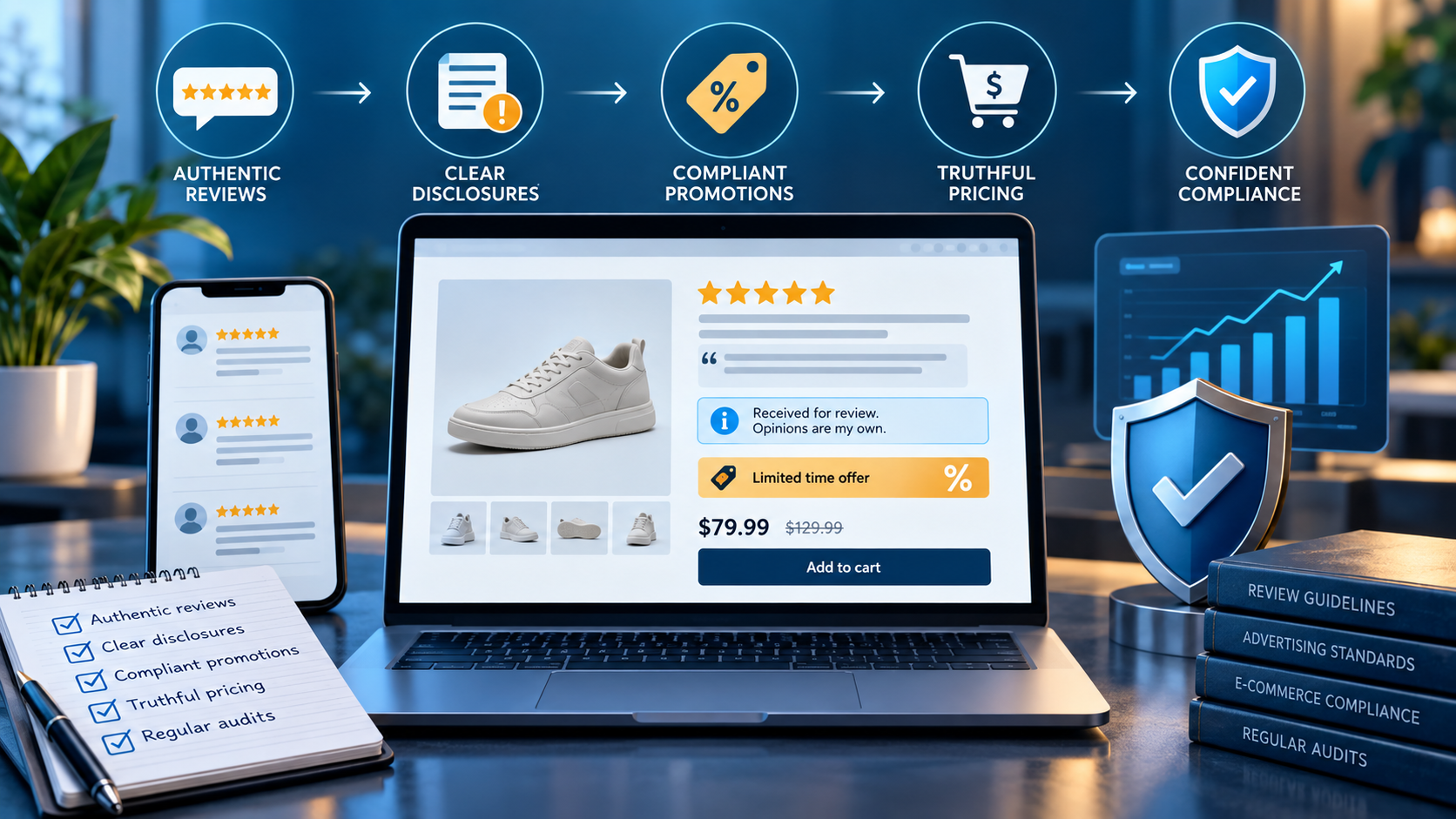
Quick answer: the five controls every campaign needs
- Evidence for objective product and savings claims.
- A real reference price and an accurate campaign period.
- Clear disclosure of paid, gifted or affiliated endorsements.
- Review collection and moderation rules that do not distort consumer feedback.
- Consistent terms across the ad, product page, cart and checkout.
FTC Consumer Reviews and Testimonials Rule
The FTC’s Consumer Reviews and Testimonials Rule took effect on 21 October 2024. It addresses practices including fake reviews, reviews from people who did not have the claimed experience, certain review suppression, incentives conditioned on a particular sentiment, and misuse of fake social-media indicators. The rule can apply to sellers, agencies and intermediaries depending on their conduct.
Read the FTC’s official Consumer Reviews and Testimonials Rule Q&A. Our separate FTC Consumer Review Rule compliance guide explains the core seller obligations in more detail.
Do not condition an incentive on a positive review
A coupon, free item or loyalty point can create a material connection. The disclosure should explain the incentive in language consumers understand. The request must not expressly or implicitly require a five-star or positive review. Review gating—asking satisfied customers to post publicly while directing dissatisfied customers to a private channel—can also create a misleading picture.
The FTC’s guide on soliciting and paying for online reviews gives practical examples for marketers.
Influencer and affiliate disclosure checklist
- Disclose payment, free products, commissions, employment and close personal relationships.
- Place the disclosure where users will see it before or with the endorsement.
- Use plain wording such as “Ad,” “Sponsored,” or a clear explanation of the benefit received.
- Repeat the disclosure in video and live content when viewers may join at different times.
- Give creators written instructions and monitor a reasonable sample of posts.
- Preserve the brief, contract, approvals and screenshots.
See the FTC’s official Disclosures 101 for Social Media Influencers.
Discount and strike-through pricing review
A crossed-out price should reflect a genuine comparison. Before advertising “50% off,” document what price is being compared, where and when it was offered, whether the offer is available to all customers, and whether unavoidable charges change the total. A countdown timer should end when stated rather than automatically resetting for every visitor.
- Record the reference-price period and source.
- State membership, quantity, coupon and geographic conditions.
- Make mandatory charges prominent at the point the price is first shown when required.
- Synchronize marketplace, product-feed and website prices.
- Test the promotion from ad click through checkout on mobile and desktop.
Operational scenario: a campaign that creates three risks
Imagine a seller offers creators free products and commission, asks buyers to “leave a five-star review for a coupon,” and displays a strike-through price that was never the ordinary selling price. Even if the product itself is lawful, the campaign creates endorsement, review and pricing exposure. A correction plan should stop the problematic request, notify creators of disclosure duties, correct the reference price, preserve campaign records and assess whether affected reviews or ads must be removed or amended.
EU campaigns need a separate review
Campaigns directed to EU consumers should also be reviewed under EU consumer-protection rules and the law of the destination country. The European Commission describes misleading actions, misleading omissions and aggressive practices in its Unfair Commercial Practices Directive overview. Local rules may impose more specific requirements for price reductions, environmental claims, subscriptions and language.
Build a repeatable promotion approval process
- Identify the countries, channels and audience.
- List every express and implied claim.
- Collect evidence and define required disclosures.
- Review platform-specific promotion and review policies.
- Approve final creative, landing page and checkout together.
- Monitor creator posts, customer complaints and price execution.
- Archive the complete campaign file.
Request an e-commerce promotion compliance review
Jinyuan Law Firm assists cross-border sellers with advertising review, influencer and affiliate controls, review programs, promotion terms, platform-rule compliance and response plans. Provide the target countries, campaign brief, proposed claims, creator arrangement, prices and launch date.
This article provides general information and is not legal advice. The applicable rules depend on the market, product, platform and campaign facts.