

E-commerce product listing compliance determines whether a cross-border seller can keep products live, protect its advertising account and avoid costly recalls in the United States and European Union. If your team is asking “Why was my product disapproved?”, “What claims can I place in a listing?” or “What documents must appear on an EU product page?”, use this checklist before publishing or appealing a removal.
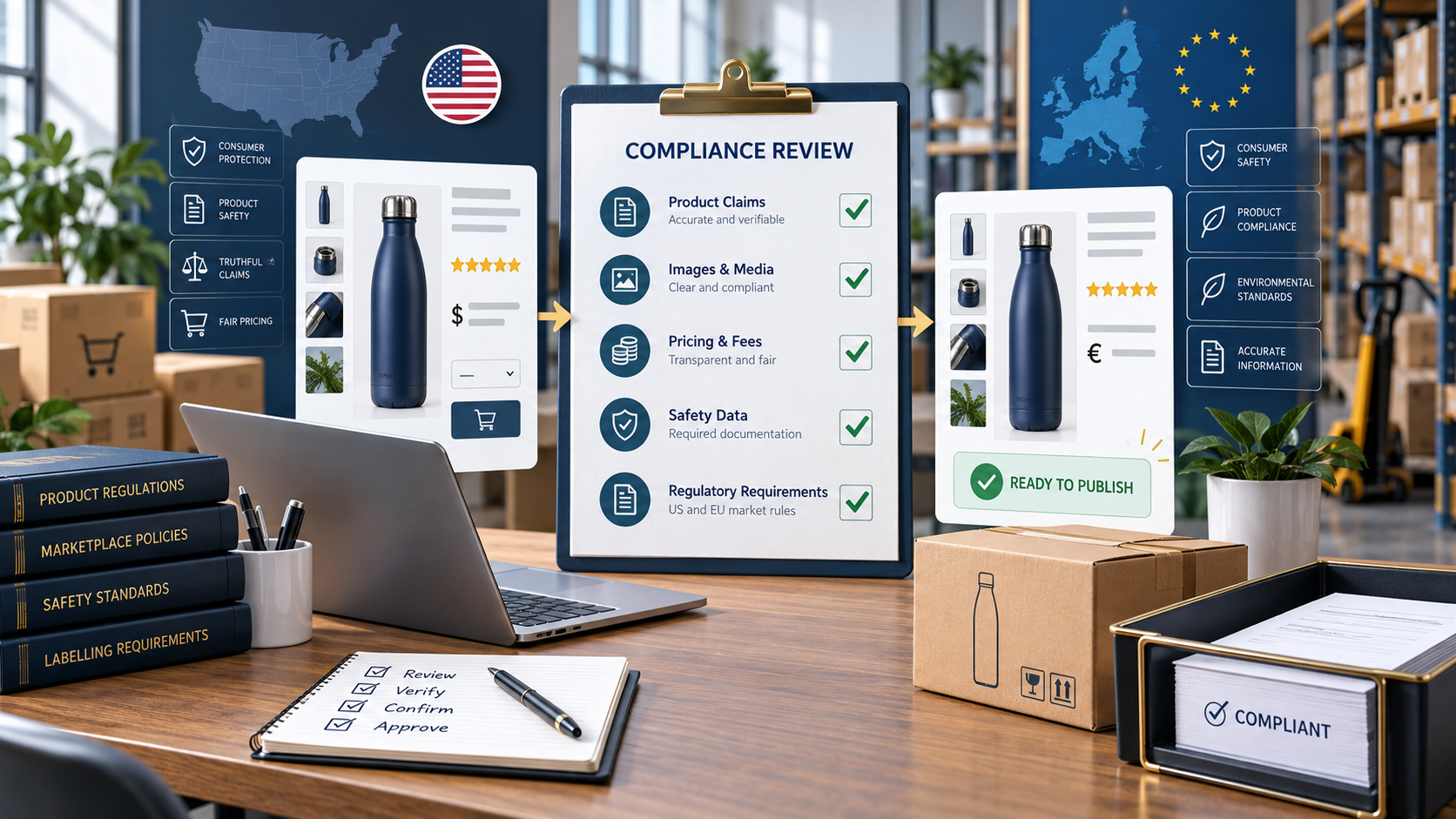
Quick answer: what should a compliant product listing contain?
- An accurate product identity and description that matches the item supplied.
- Claims supported by evidence available before the claim is published.
- Original or licensed photographs, graphics and copy.
- A transparent total price, material limitations and promotion conditions.
- Required manufacturer, responsible person, warning and traceability information.
- Shipping, return and customer-service information consistent across the listing and website.
Why listings are removed even when the product is genuine
Marketplaces and advertising channels compare the listing, product feed, website, business identity and customer experience. A seller can therefore face a disapproval even when the physical product is genuine. Common triggers include unsupported “best,” “safe,” “FDA approved” or environmental claims; inconsistent prices; copied images; hidden subscription terms; missing safety information; and a mismatch between the seller name, payment account and website.
Google’s official guidance explains that product data quality violations can lead to warnings or disapprovals and directs merchants to correct the underlying data before requesting review. See the Google Merchant Center product data quality guidance.
US product description and advertising review
Under the FTC’s truth-in-advertising principles, objective claims must be truthful, non-deceptive and supported by evidence. The review should cover the headline, bullets, comparison charts, images, demonstrations, testimonials, FAQs and metadata because consumers may take an overall message from the full presentation.
- Performance claims: retain reliable testing that matches the advertised use and conditions.
- Health and safety claims: identify the applicable regulator and avoid implying government approval unless it exists.
- Environmental claims: define the benefit and its limits rather than using an unqualified green claim.
- Price claims: confirm the reference price, duration and eligibility conditions.
- Endorsements: disclose material connections clearly and close to the claim.
For the governing principles, consult the FTC Advertising FAQ for small businesses.
EU product page requirements after the GPSR
For consumer products offered in the EU, the General Product Safety Regulation has applied since 13 December 2024. Depending on the product and supply chain, an online offer may need manufacturer information, an EU responsible economic operator, product identification, and warnings or safety information that consumers can understand before purchase. These details should be displayed in the listing itself instead of being available only after delivery.
Use the European Commission’s General Product Safety Regulation overview, then review our practical EU GPSR compliance checklist for China e-commerce sellers.
Image, keyword and intellectual property checks
- Confirm ownership or a valid licence for every photograph, icon, video and paragraph.
- Search trademarks before placing a competitor’s brand in a title, keyword or backend field.
- Do not edit images in a way that changes the apparent size, quantity or performance.
- Keep version records showing when and why each creative asset was approved.
- Check whether packaging, product shape or decorative features create design-right risk.
Promotion and price checklist
A strike-through price, “limited time” banner or bundle can be deceptive if the reference price was not genuine, the deadline repeatedly resets or mandatory charges appear late. Record the regular price history, define who qualifies, state geographic limits, and make unavoidable charges visible before checkout.
Operational scenario: a compliant product with an inconsistent listing
Consider a seller whose product tests and certificates are valid, but whose US listing says “100% non-toxic,” the EU page omits the responsible person, and the product feed shows a different sale price from the landing page. A platform review may treat these as separate compliance failures. The effective response is a documented root-cause review: remove or qualify the unsupported claim, add the EU traceability fields, synchronize the price feed, preserve screenshots, and only then request review.
Pre-publication evidence file
- Final listing text and screenshots by marketplace and country.
- Test reports, certificates and claim substantiation.
- Trademark searches, image licences and supplier permissions.
- Manufacturer and responsible-person records.
- Price history, promotion rules and disclosure approvals.
- Named reviewer, approval date and next review date.
When to obtain legal review
Legal review is especially useful before launching a regulated product, using comparative or health claims, expanding from the US to the EU, responding to repeated disapprovals, or relying on supplier documents that do not match the listing. Jinyuan Law Firm assists cross-border sellers with platform-entry review, product listing compliance, advertising review, operational policies and penalty appeals.
Request a product listing compliance review
Send the target marketplace, sales country, product category, draft listing, notices received and supporting documents. We can identify the highest-risk issues and prepare a prioritized correction plan.
This article provides general information and is not legal advice. Requirements depend on the product, market, platform and facts.